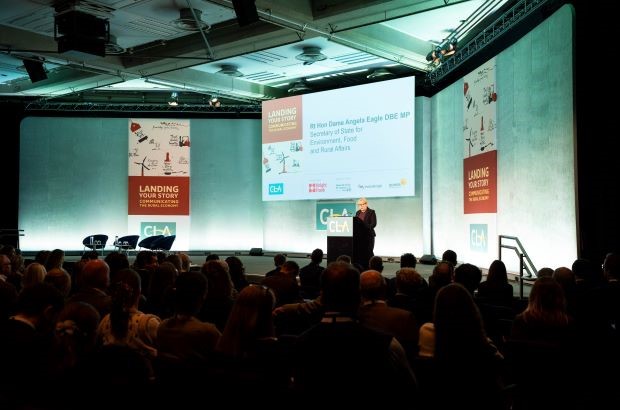
Today, Secretary of State Dame Angela Eagle addressed the Country Land and Business Association (CLA) Rural Business Conference.
In her speech, the Secretary of State announced a package of measures that will help support growth in rural postcodes and put agricultural at the heart of our economy, security, and national identity.
The package included measures to help farm businesses in England invest, grow and become more resilient.
This post brings together the main updates, including support for on-farm reservoirs, work to help farmers access private investment, and an update on Countryside Stewardship Higher Tier (CSHT).
Growth
Funding for soil and water innovation
The Farming Innovation Programme (FIP) ‘Healthy Soils and Water for a Sustainable Environment’ competition’ opened for applications today (19 November 2026).
Up to £28 million is available for innovative projects to improve soil health, water quality and environmental management in livestock and cropping systems on farms in England. This is the largest FIP competition since it launched in October 2021.
This funding will give farmers and rural businesses across the country the tools to become more productive and resilient, while creating opportunities for innovative businesses and technologies to grow.
Read our dedicated Farming Blog post for more information about the competition and where to find application guidance.
Rural communities
Rural areas make up over 85% of England’s land mass. Rural England is home to 9.7 million people (17% of the population in 2024), and rural areas contributed over £259 billion (12%) to the economy in England in 2023.
Thriving rural communities and a prosperous rural economy will be underpinned by improvements in rural connectivity (transport and digital), availability of affordable housing and energy, and access to a range of community services.
In July, we published the Future of Rural England report, which includes practical recommendations to place rural communities at the heart of government decision-making. The report builds on the work of the Defra-led Rural Taskforce, working across Whitehall and with external partners to support rural businesses and tackle rural disadvantage.
The report confirmed plans for a cross-government rural proofing board so rural needs are considered as policy is developed. Annual reporting will make it clearer how departments are delivering for rural England.
Farmer Collaboration Fund
The Farmer Collaboration Fund helps farmers and land managers work together on local projects to improve productivity, sustainability and resilience. It funds organisations that support new and existing clusters and collaboration groups.
We received a high number of applications for Round one of the fund and are assessing them. Successful applicants will be notified soon. We'll publish the list of recipients on the blog in due course.
Read more about how the Farmer Collaboration Fund supports farmers working together.
Nature markets
We’ve set up the Farming Profitability and Private Finance Taskforce to help farmers access private investment. It will focus on practical opportunities to support more productive, resilient and sustainable farming systems.
We’re delighted that Lloyds Banking Group will support Defra in co-chairing the taskforce.
Our recent publication, Growing Places, sets out how we are working to help connect private finance with the needs and opportunities presented by nature markets for healthier, more resilient places. This includes, for the first time, proposing principles for combining public and private environmental payments.
We want your views to help shape these principles. You can contact Defra at naturemarkets@defra.gov.uk or register for upcoming webinars on combining public and private environmental payments:
You only need to register for one webinar. Both webinars will cover the same content: background to the principles proposed in Growing Places. There will be an opportunity to ask questions live and you can also pre-submit them when you sign up for the events.
A long-term vision for the tenanted sector
Defra is inviting the tenanted sector to work with us to develop a shared plan to build a resilient, profitable and productive tenanted sector, as part of the next step to deliver the Farming Roadmap.
We want to build a tenanted sector where tenants have confidence to invest and grow their businesses and landlords have confidence to let land and invest in their tenanted holdings. Supporting existing tenants and new entrants.
Over the coming months, we'll work with industry representatives – including the CLA, TFA, NFU and professional bodies - to set up workshops with tenants, landlords and advisors to gather views.
Anyone interested in getting involved can contact Defra at agriculturaltenancies@defra.gov.uk and we will be in touch with a list of engagement opportunities in due course.
You can read more about our plans to develop a vision for the tenanted sector in this blog post.
Join Tenant Farmers Association (TFA) webinar: one year with Alan Laidlaw
Join Alan Laidlaw, Commissioner for the Tenant Farming Sector, for a free webinar with the Tenant Farmers Association (TFA) on 25 November 2026 at 7pm. Alan will reflect on his first year in the role and discuss his priorities for the year ahead, what they mean in practice for tenant farmers and how progress will be measured.
Resilience
Helping farms grow also means helping them prepare for drought and build businesses that can withstand the impacts of geopolitical shocks and a changing climate. These updates cover water management, environmental land management, fertiliser supplies and food production.
Fertiliser supplies and resilience
The UK remains reliant on imports for our fertiliser supplies, making our farming sector vulnerable to global market disruptions and price fluctuations.
We’ve published a short paper today which sets out our initial plans for developing a Fertiliser Sustainability and Resilience Plan for England. We are inviting stakeholders to contribute ahead of a full plan to be published in the spring.
The aim is to boost the UKs fertiliser supply resilience, identify areas where we can take a more holistic approach to nutrient management, and reduce reliance on imports. We are wanting to set out a longer-term plan to start this transition, aligned with our farming roadmap commitments, water regulations and circular economy goals.
Water management and on-farm reservoirs
Today (19 November) we've published the guidance for round 3 of the Water Management Grant, which will provide up to £15 million to support on-farm reservoirs and water tanks. Guidance and eligibility criteria have been published.
The application window will open on 30 November 2026 and will close on 23 February at 11:59pm.
This is a competitive grant scheme, and applications are not prioritised based on when they are submitted. Take the time you need to prepare your application before submitting it.
Read our dedicated Farming Blog post for more information about the grant, the published guidance, a webinar for those considering applying and the steps government is taking to make it easier to build and use reservoirs.
Sustainable Farming Incentive (SFI)
We know the high demand for the SFI has raised concerns about access to funding.
Defra is working at pace to improve SFI for next year – continuing our close work with farmers and stakeholders by listening to experiences and learning lessons from this window.
Ministers have confirmed we will move away from a first come first served application process for SFI in 2027. We are exploring alternatives as part of this engagement with the sector.
We’re also looking at how we can give farmers clear guidance and support, so they have plenty of time to get ready to apply.
We will provide further details on the future of SFI in due course.
The RPA continue to issue agreement offers to those who applied for SFI26. As of 18 November:
- 6,655 agreement offers have been issued to Window 1 applicants - 99.5% of total applications in this window
- 10,491 agreements have been offered to Window 2 applicants - 86% of all applications in this window
- Across both windows, 17,146 agreements have been offered out of 18,882 submitted applications (90.8%)
We’re also confirming today that we’ve increased payment rates for moorland actions in SFI24, aligning with equivalent rates in the SFI26 offer. More information can be found below.
Countryside Stewardship Higher Tier (CSHT)
We’ve recently made several improvements to CSHT to give more farmers access to funding.
Commons Trial
We’ve started a trial for a small number of commoners to test the new application approach and digital service. The selected commons have been working with advisers from Natural England and the Forestry Commission to finalise their applications.
We’ll provide an update on the progress of the trial in early January, and subject to its success, an update on when we expect the wider rollout to commence.
Increasing moorland payment rates
We’ve increased payment rates for a select number of moorland actions, as confirmed in previous blogs. This aligns equivalent SFI24 and CSHT actions (for agreements that started in 2025), with rates in the SFI26 offer.
This ensures those farming above the moorland line are properly compensated for the action they’re taking to improve the condition of moorland habitats.
Letters have now been sent to all affected agreement holders outlining the changes.
The increases will apply to existing SFI24 agreements and new and existing CSHT agreements. Payments will be backdated to the start of each agreement. Farmers do not need to take any action; current and future payments will be adjusted automatically.
Details of the payment rate increases can be seen below.
SFI24 payment rate increases:
- UPL1: Moderate livestock grazing on moorland, from £20/ha to £35/ha
- UPL2: Low livestock grazing on moorland, from £53/ha to £89/ha
- UPL3: Limited livestock grazing on moorland, from £66/ha to £111/ha
- UPL8: Shepherding livestock on moorland (remove stock for at least 4 months), from £43/ha to £74/ha
- UPL9: Shepherding livestock on moorland (remove stock for at least 6 months), from £45/ha to £88/ha
- UPL10: Shepherding livestock on moorland (remove stock for at least 8 months), from £48/ha to £102/ha
CSHT actions:
- CUP8: Moderate livestock grazing on moorland, from £20/ha to £35/ha
- CUP9: Low livestock grazing on moorland, from £53/ha to £89/ha
- CUP10: Limited livestock grazing on moorland, from £66/ha to £111/ha
- CUP12: Shepherding livestock on moorland (remove stock for at least 4 months), from £43/ha to £74/ha
- CUP13: Shepherding livestock on moorland (remove stock for at least 6 months), from £45/ha to £88/ha
- CUP14: Shepherding livestock on moorland (remove stock for at least 8 months), from £48/ha to £102/ha
Single-focus agreements
Earlier this month, we opened expressions of interest for two new single-focus agreements covering traditional orchards and wet grassland for wintering waders and wildfowl. These simplified agreements focus on delivering priority environmental actions.
They build on the single-focus agreements introduced in July for species-rich grassland and scheduled monument management, which remain open for expressions of interest.
Read our blog post on new CSHT single-focus agreements for eligibility restrictions, how to express an interest and seasonal survey requirements for species-rich grassland.
Since we launched the EOI process in July, we have been increasing capacity so we can accept more expressions of interest across all four single-focus agreements than we originally had capacity for. We will continue to keep that under review taking account of demand.
All four single-focus agreements are currently open for expressions of interest.
New actions
Work is ongoing to introduce the updated 'Manage rough grazing for upland breeding waders' action. We aim to make this new action live before the end of the year.
As announced in July this year, we also hope to provide details of the CSHT Pony Supplement soon.
Subscribe to the blog to receive a notification when we publish a new post.
Farming in Protected Landscapes
The Farming in Protected Landscapes (FiPL) programme provides funding for farmers and land managers to work in partnership with National Parks and National Landscapes in England to deliver projects that achieve outcomes for climate, nature, people and place.
As announced at the Oxford Farming Conference in January, we have extended FiPL for a further three years, to March 2029, with £30 million of funding available in 2026/27 alone. This will support delivery against Defra’s environmental targets and Protected Landscape priorities, while complementing Environmental Land Management (ELM) schemes through locally tailored projects and advice.
An evaluation of 24/25 extension of the FiPL programme published this week, assesses what has worked, the value for money of the programme and the impacts of funded projects.
Farmer Welfare Grant
The Farmer Welfare Grant funds practical support to help farmers in England manage the pressures they face. It supports organisations working closely with farming communities to strengthen farmers’ mental health, wellbeing and personal and business resilience. The Farmer Welfare Grant closed for applications on 9 September.
We received a high number of applications and successful applicants will be notified soon. We'll publish the list of recipients on the Farming Blog.
Read more about the support the Farmer Welfare Grant aims to provide.





Leave a comment