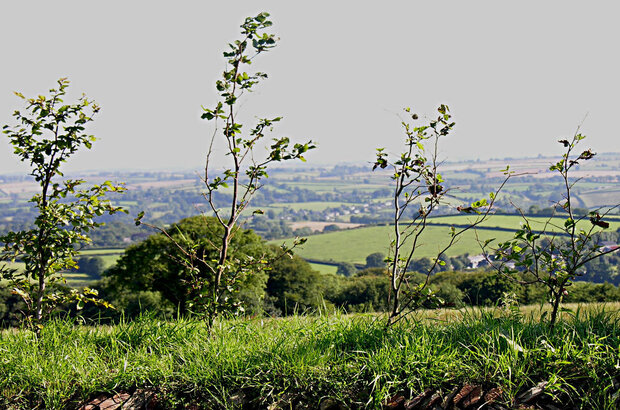
Through Capital Grants in 2026, £225 million will be available to support farmers, land managers and rural businesses to deliver environmental improvements across England.
When the offer opens in July, Capital Grants will fund a range of items from hedgerow and tree planting through to works that improve water quality.
We are currently finalising the items that will be available in this year's offer. The full list will be published in May alongside the guidance ahead of the offer opening.
In the same way as last year’s offer, the items will be organised into the following groups:
- Boundaries, trees and orchards
- Water quality
- Air quality
- Natural flood management
- Assessments
- Improvements
Funding limits will continue to apply to 4 of the 6 groups in the offer:
- £25,000 for the water quality, air quality, and natural flood management groups
- £35,000 for the boundaries, trees and orchards group.
Each application can include items from these groups up to the limit, plus items from the assessments or improvements group.
As in 2025, you can submit one application per Single Business Identifier (SBI) you manage.
Demand for last year’s offer was very high, and we expect strong interest again this year. Once the offer opens, we’ll share updates on the blog as 25%, 50% and 75% of the funding is allocated.
We’ll share guidance on how to apply before the offer opens.
Get ready to apply: supporting evidence
We have always required supporting evidence for Capital Grants.
This year, we are placing greater emphasis on receiving it upfront so we can assess applications more quickly and fairly and make the best use of the available funding.
Last year, a high number of applications required follow-up for missing evidence. This led to additional chasing, slower decisions, and in some cases, applications being rejected where evidence was not provided in time.
Demand for Capital Grants is expected to be high again in 2026, with more applications than funding available. Submitting complete applications with all required evidence, will help us process requests efficiently and ensure decisions are made in a timely way.
We’ve highlighted the most common types of evidence below; alongside the steps you can take now to prepare.
Full details will be published in the Capital Grants applicant’s guide.
Claim for completed works
If you have already completed capital works under a Countryside Stewardship Mid Tier, Higher Tier or Capital Grant agreement, make sure you submit your claim for those works.
You should also confirm in the customer portal if this is your final claim for those works.
This is important, as it releases the land parcel from your existing agreement so you can include it in a new application.
Check your details are up to date
Check that you and your business are registered with the Rural Payments Agency (RPA). Register and update your details with the Rural Payments Agency on GOV.UK.
Once registered, make sure your details are up to date, including your business information.
You should also check that your land parcels are correctly mapped and registered in the Rural Payments Service.
Check your maps are up to date
Check your land mapping. Add or amend land parcels as needed by following the guidance to update it.
Evidence: Evidence: Maps are required as supporting evidence to clearly show the location of capital works, or identify the historic feature to be restored, or outline the area assessed under the woodland condition assessment.
Check you have sufficient funds
Capital Grants are paid after the work is finished. This means you’ll need to pay for the work first and then claim the money back. Because of this, we need to check that you can afford to carry out the work in your application.
If your application is worth more than £50,000, the RPA will need to check that you have enough funds to pay for the work.
It’s a good idea to estimate the value of your application in advance so you know if you’ll need this. You can use the Capital grant finder on GOV.UK to check the payment rate for each item.
Evidence: You must provide a letter on headed paper from a qualified accountant, who is chartered or certified, or registered with a recognised professional body such as the ACCA (Association of Chartered Certified Accountants), ICAEW (Institute of Chartered Accountants in England and Wales), CIPFA (Chartered Institute of Public Finance and Accountancy) or CIMA (Chartered Institute of Management Accountants). The letter must confirm that your business, or Single Business Identifier (SBI) has sufficient funds from profits, reserves or loans to carry out the work outlined in your application.
Catchment Sensitive Farming support
Following the closure of the 2025 Capital Grant offer, Catchment Sensitive Farming (CSF) advisers have been working with farmers and land managers to prepare for the 2026 round.
A high number of support visits have been completed, which will enable people to apply for the 24 items that require support when the window opens.
CSF advice has been very popular over this period, so advisers are now prioritising advice and support visits already requested to help prepare for the 2026 round.
CSF area teams will not be able to prioritise any new requests for advisory visits for this round but will be able to offer advisory visits later this year. They will get in touch when they have capacity to help. In the meantime, you can register for one of their free events.
Evidence: For the 24 items listed below, you must have CSF support in place before the offer opens in July. If you have received CSF support in the last 2 years for these items, you can use this support when you apply.
AQ2: Low ammonia emission flooring for livestock buildings
RP4: Livestock and machinery hardcore tracks
RP13: Yard – underground drainage pipework
RP17: Storage tanks underground
RP19: First flush rainwater diverters and downpipe filters
RP20: Relocation of sheep dips and pens
RP21: Relocation of sheep pens only
RP22: Sheep dip drainage aprons and sumps
RP23: Installation of livestock drinking troughs (in draining pens for freshly dipped sheep)
RP24: Lined biobed plus pesticide loading and washdown area
RP25: Lined biobed with existing washdown area
RP27: Sprayer or applicator load and washdown area
RP29: Self-supporting covers for slurry and anaerobic digestate stores
RP30: Floating covers for slurry and anaerobic digestate stores and lagoons
RP31: Equipment to disrupt tramlines in arable areas
TE5: Supplement for use of individual tree-shelters
Requirements for tenant farmers
If you are a tenant, check whether you need your landlord’s agreement before you apply. You will need their countersignature if your tenancy does not last for at least 5 years from the start of your agreement.
Evidence: You will be required to supply a land ownership control form if you are a tenant and you do not have a tenancy which lasts at least 5 years from when you apply
Other evidence
Some items may need additional evidence to support an application for that item such as consent from Historic England for works on historic or archaeological sites. You can check your Historic Environment Farm Environment Record (HEFER) to see if you have any features that need advice or consent.
You can check the evidence requirements for each item before you apply by searching for the item’s code on the capital grant finder.
Subscribe to the Farming Blog
Subscribe to the Farming Blog to stay up to date with the latest information on Capital Grants.
We’ll share updates when the guidance is published and when the offer opens.
If you subscribe, you’ll receive an email notification as soon as we publish a new post, so you won’t miss anything.



 The
The 
Leave a comment