Published today, the Organic Action Plan for England (OAPE) sets out how government and the organic sector will work together from 2026 to 2036 and beyond, to grow domestic production, improve market opportunities and help more people understand what organic farming offers.
Publication of the plan is the next step in the delivery of government’s ‘Farming Roadmap 2050: Growing England’s Future’. The Farming Roadmap acknowledges the vital role that organic systems play in improving soil health, cutting chemical and synthetic inputs, and supporting biodiversity.
Organic farming is a whole-farm approach that can help farm businesses reduce their exposure to input costs, such as artificial fertiliser and pesticides, and reach markets where demand is growing.
It can also support healthier soils, cleaner water, more wildlife and high standards of animal welfare.
Defra-funded research shows strong links between organic farming and benefits for biodiversity, soil health and reduced chemical exposure. It also shows how organic systems can support climate adaptation.
Consumer demand for organic products continues to grow. UK organic retail sales reached £3.9 billion in 2025. The plan aims to support English farmers to fulfil a greater share of this growing market, with an ambition to increase the proportion of agricultural land farmed organically from around 3.4% towards 10% by 2036.
Organic food plays an important role in public procurement. Produce qualifies under the Higher Environmental Production Standards within the Government Buying Standards for Food and Catering Services. Programmes such as Food for Life Served Here show what can already be achieved, with 22 catering providers spending £7.5 million on organic produce in 2024.
There’s a strong opportunity for English farmers, growers and food businesses to expand domestic production.
In this post, we look at how government and industry action - aligned with the themes and outcomes in the plan - will help encourage more farmers to convert to an organic farming system.
Purpose of the plan
Defra has collaborated with the English Organic Forum (EOF), a group of organic organisations that work together to represent the sector, to develop a plan that responds to the sector’s needs, with direct input from organic producers and sector leaders across the country. Defra and the EOF will jointly oversee its delivery.
The plan is primarily focused on England, but some actions will involve partners across the UK. It's a 10-year plan but includes action that will stretch beyond 2036.
The OAPE recognises that organic farming is not the right choice for every farm but, for some businesses, organic production can offer a stronger route to market and lower exposure to some input costs.
The plan sets out a clear pathway to grow England's organic sector and create more opportunities across the supply chain.
For farmers and growers, it aims to provide better access to information, advice, innovation and peer support, making it easier to start or expand organic production.
For businesses, it seeks to improve understanding of where domestic supply can meet demand, helping producers, processors and buyers identify new market opportunities.
For consumers and public sector buyers, it aims to increase awareness of organic certification and encourage greater uptake of English organic produce.
What this means for farmers and growers
The plan is designed to sit alongside existing agri-environment schemes (AES). Since 2024, the Sustainable Farming Incentive (SFI) has included options for organic conversion and maintenance. As committed in the first year of the plan, Defra will maintain and clearly explain the organic offer within Environmental Land Management (ELM) schemes for farmers considering organic conversion.
In order to grow organic production, the OAPE focuses on actions that break down other barriers to farmers converting to an organic farming system. This includes access to information, advice, peer networks, markets and supply chains.
The English Organic Forum and the wider sector will build on existing services so farmers considering conversion can find information on certification, funding, business planning and routes to market.
The sector will also work to provide one-to-one guidance and learning between farmers.
Further work will identify opportunities in horticulture, arable, dairy, red meat and poultry. Opportunities will be underpinned by better data on organic production, trade and purchasing, so farm businesses can make decisions using clearer evidence.
Case studies
We have spoken with two farm businesses about their experiences of working within an organic farming system:
Riverford Organic Farmers
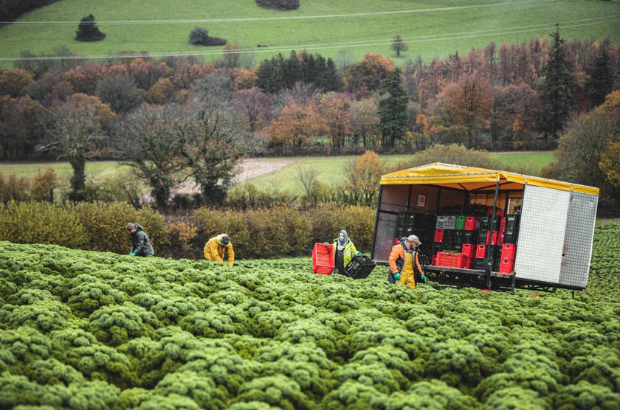
Riverford Organic Farmers began in 1986. Guy Singh-Watson started growing organic vegetables on three acres at Wash Farm in Devon. The company has since grown from the UK’s first organic veg box into a business with over £100m annual turnover, delivering directly to around 70,000 customers each week.
They became employee-owned in 2018, with 100% of the business now held in an Employee Trust for the equal benefit of its approximately 1,000 employees.
Certified organic since 1989, they grow and sell food without artificial pesticides or fertilisers, GM ingredients, routine antibiotics, or artificial preservatives and colours.
Organic farming supports Riverford’s long-term resilience. Improving soil fertility, biodiversity, carbon and water storage helps the farm cope with increasing floods and drought and maintains productivity levels. It also underpins the business’s commercial identity, giving customers confidence that their food is produced to clear, trusted and independently certified organic standards.
Riverford’s principal route to market is its organic box scheme, with 70% of box contents grown in the UK and produce delivered directly from farm to customer.
The business has long-term partnerships with growers across the country, supported through its Supplier Charter, which commits to agreed prices and volumes, accepts cosmetically imperfect produce and promotes collaborative solutions when crops vary.
Riverford also works with their farmers to assess and improve performance across soil health, water, biodiversity, carbon, animal welfare and social impact.
Shimpling Park Farm
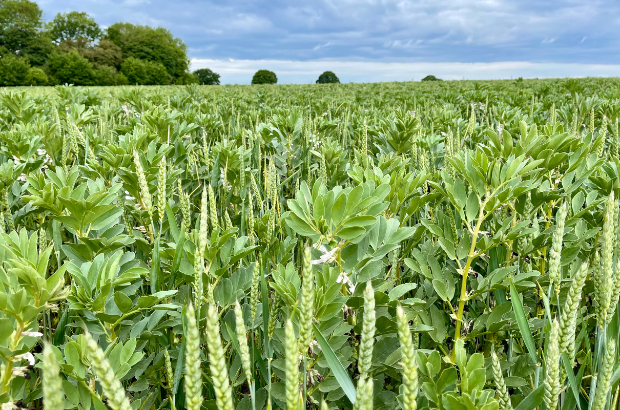
Shimpling Park Farm, owned and run by John, Alice and Rufus Pawsey, is a 700-hectare mixed organic farm near Bury St Edmunds in Suffolk, managed as a whole-farm organic system and certified by the Soil Association.
The farm grows combinable crops including milling oats, spelt, heritage wheat, quinoa, chia and lentils, alongside herbal and fertility leys. Around 200 New Zealand Romney sheep graze two-year grass-and-clover leys, integrating livestock with the arable rotation.
The organic mixed-farming system links crops, leys and livestock to build fertility and reduce reliance on external inputs. Grass, clover, legumes and herbal leys support soil health and biodiversity, while sheep turn forage into a saleable product and contribute to the rotation. As part of their system, roughly 90 hectares of leguminous and herbal leys help build soil health, biodiversity and nature.
On-farm trials also help the business identify practical approaches that can maintain yields while strengthening nature and long-term resilience. The team trials different seed rates, weed and disease controls, bi-cropping, green manures and undersowing to improve crop production while enhancing the environment.
A diverse crop base, local flour milling, building rentals and other activities provide diversified income streams.
The Shimpling team have an open and collaborative approach welcoming many people to their farm for wider connection and learning.
The farm uses Sustainable Farming Incentive (SFI) and Countryside Stewardship scheme funding to focus on landscape restoration, farmland birds and education. It is also participating in a Landscape Recovery pilot through the Suffolk Wool Towns cluster, which aims to connect ancient and secondary woodlands across 20,000 hectares. Earlier Countryside Stewardship funding supported pond restoration, the restoration of two medieval moated sites and medieval wood pasture, hedge replanting, and coppicing of ancient woodland.
Stay up to date
Read the Organic Action Plan for England to see the full actions and timescales.
We’ll continue to work closely with the organic sector as the plan progresses and share further updates on the Farming Blog.
We’ll also post a blog about future funding opportunities for farmers to convert to an organic farming system.
Subscribe to the blog to receive an email notification whenever we publish a new post.

10 comments
Comment by susie nielsen posted on
Its a shame they didn;t include organic conversion options via higher tier CS rather than just the first come first served SFI
Comment by Tom Goss posted on
Hi Susie,
Thanks for your comment. Countryside Stewardship Higher Tier is highly targeted at SSSIs and Priority Habitats. As such organic farming is a better fit with the design principles of SFI, making it accessible for more farmers.
We are continuing our close work with farmers and stakeholders to look at how we can improve SFI for next year. As part of this, we are exploring alternatives to a first come, first served application process for SFI in 2027.
Thanks,
Tom
Comment by Simon Ward posted on
I am disappointed that government feels that it needs to become involved with a marketing initiative such as organic farming.
Organic farming tends to lead to more diffuse pollution (such as seen in many of the nutrient neutrality areas). Organic prouction also tends to either severely reduce the food produced per unit area or increase the greenhouse gas per unit of food output, and slightly lower food output, compared with convetional farming where livestock are introduced. Thus it reduces our ability to feed ourselves and thus has a negative impact on food security.
I greatly admire and support those innovative people that have adopted imaginative premium farm outputs and new systems (such as Shrimpling Farms). There is definitely room for some businesses of this nature within the wider farming industry. However, encouragement to others to adopt similar systems only serves to reduce the profitability of those courageous entrepreneurs. Ultimately, it is in the growers' interests to develop products that can be sold at a premium.
If the driver is biodiversity I suggest that those involved in policy should at least listen to Cambridge University's Professor Andrew Balmford's Royal Society paper https://royalsociety.org/science-events-and-lectures/2026/06/environment-prize-lecture/. Policy needs to be based on evidence.
I am more than happy to assist government to formulate an effective policy.
Comment by Tom Goss posted on
Hi Simon,
Thanks for the feedback, your comment has been passed to policy colleagues who will consider this as we begin to implement the plan.
Thanks,
Tom
Comment by Craig Sams posted on
La Vialla have had their carbon footprint measured by the U. of Siena for more than a decade. They average 7 tonnes CO2e per hectare per annum. If conventional farmers paid for their carbon emissions and organic farmers got paid for carbon capture then organic food would be cheaper than non-organic. The statistics contradict your assertion that organic farming has a higher carbon footprint. If we stopped wasting land on biofuel production (1/2 the 100 billion acre US corn crop is converted to gasoline) your anxieties about lower yields would be addressed.
Researchers from the University of Siena’s Department of Biotechnology (working in partnership with the Fabbrica del Sole) have monitored and calculated the annual carbon cycle and greenhouse gas balance of Fattoria La Vialla—a large Demeter-certified biodynamic farm covering roughly 1,600 hectares in Tuscany, Italy.
Key Findings of the Collaboration
• Soil Organic Matter (SOM) Growth: Long-term biodynamic management (including green manuring, crop rotation, and natural compost application) has increased organic matter in the soil by roughly 2% over the last decade, allowing the soil to actively fix and store carbon rather than releasing it.
• Carbon Sequestration & Absorption: The studies evaluate the combined capacity of La Vialla's expansive ecosystems—including extensive oak woodlands (~759–988 hectares), olive groves, vineyards, arable fields, and pastures. Depending on the specific multi-year evaluations and IPCC accounting methodologies used, findings indicate substantial annual net carbon capture (averaging around 4 to 10 tonnes of CO₂ equivalent per hectare per year across different land types).
• Carbon Neutrality Certification: By subtracting avoided emissions (such as from on-site photovoltaic solar plants and phyto-purification water systems) and natural carbon fixation in the soil and forests from total operational emissions, the University of Siena's analyses have helped certify La Vialla as a carbon-neutral company.
Comment by Simon Ward posted on
I am not sure this is thought through. Transfer of manures from other holdings and low production with leys will increase carbon but only at the expense of harvestable food energy. Grazing livestock are so inefficient that soil carbon, particularly when going from arable to grass, will increase becaus more organic matter is left behind but only to the point of a new equilibrium. The annual emissions from introducing livestock will increase emissions per unit of food energy produced in the longer term.
I am not sure I support biofuels although they are one of the means of using grass on arable organic farms with return of nutrient and at least some organic matter. Again organic matter can rise but only to a new equilibriun so it is not a sustainable annual gain.
Longer term I would like to think that nitrogen fertiliser would be produced using quantum chemistry as plants do. In teh shorter term use of surplus wind energy to produce hydrogen (currently extracted from natural gas with carbon dioxide as a by-product) would help the transition (and release significantly less greenhouse gas than a cow producing manure).
If interested in the subleties the flux should not be ignored (but not taken into account in conventional greenhouse gas accounting). It is always interesting to see teh saw tooth impact resulting from the predominantly northern land mass.
I am not against organic farming. or regenative farming, rewilding or zoos but it is important to consider the objectives. It is important to consider where systems need improvement buy my prejudice is that it is individual practices that need addressing and not the introduction of straight jacketed systems.
Comment by Sarah Holmes posted on
The funding for transition and ongoing support for organic needs rethinking as the current method through SFI is not fit for purpose. Funding needs to be available as and when farms decide to convert as a rolling funding offer, not an extremely short window only once a year. For those who decided in April 2025 that they would like to organic, they will have waited 18 months to apply for funding through SFI and then there was only a 5 hour window which many will have missed.
Comment by Tom Goss posted on
Hi Sarah,
Thanks for your question. At this moment we aren’t considering bespoke funding for conversion to an Organic farming system, and are continuing to offer support for farmers to convert and continue to farm organically, through the SFI.
We are continuing our close work with farmers and stakeholders to look at how we can improve SFI for next year. As part of this, we are exploring alternatives to a first come, first served application process for SFI in 2027.
Thanks,
Tom
Comment by David Morley posted on
The first thing DEFRA can do is guarantee organic conversion and management payments through SFI. At the moment, organic farmers have to compete for agreements with all other SFI applicants, which is a huge barrier to organic conversion and ongoing management. Will DEFRA consider guaranteed agreements for organic actions?
Comment by Tom Goss posted on
Hi David,
Thanks for your question. At this moment we aren’t considering bespoke funding for conversion to an Organic farming system, and are continuing to offer support for farmers to convert and continue to farm organically, through the SFI.
We are continuing our close work with farmers and stakeholders to look at how we can improve SFI for next year. As part of this, we are exploring alternatives to a first come, first served application process for SFI in 2027.
Thanks,
Tom