https://defrafarming.blog.gov.uk/defra-farming-podcast-episode-19-adopt/
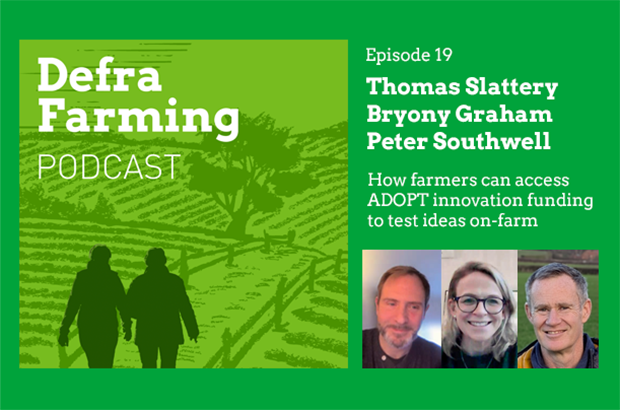
Defra Farming Podcast episode 19: ADOPT
Transcript
00:00
Tom Slattery: Hello and welcome to the Defra Farming Podcast. I'm Thomas Slattery. I lead farmer engagement, communications and knowledge exchange for the ADOPT Support Hub. In today's episode, we're talking all about the ADOPT fund, how it works and what practical experimentation on farms really looks like.
We're joined by two farmers who both have live ADOPT projects underway and we’ll be hearing directly from them about what they're testing, why they decided to apply and what they've learned so far.
So before we go any further, let's start by meeting them.
Hello, Bryony and Peter, welcome to the podcast.
Bryony Graham: Good morning.
Peter Southwell: Yeah. Hi, Thomas. Thank you for having me.
Tom: Could you introduce yourself and just tell us a little bit about your farm where you are in the world?
Bryony: Of course. So my name is Bryony Graham and I farm with my father and my brother on a 300-hectare arable farm in Essex. My brother and I are the fourth generation of our family to have farmed here. So we've been here for 100 years. My dad isn't quite that old, but I think he feels it and, despite my father's best efforts to encourage my brother and I to go and do other things, we've come back to the family business.
So I trained as a scientist and did a PhD and a post-doc elsewhere, and then came back to the business and set up a diversified income stream in the form of a wedding and events venue, but have more recently been moving back to the farming side of the business.
And we are looking to the future and how best to manage the land that we are responsible for. And we're on very, very heavy clay and changing climate patterns, particularly rainfall, is really impacting the productivity of the crops that we've traditionally grown. So we've been looking at different rotation options, different crops and part of that has led to looking for funding under the ADOPT scheme to broaden and really gather data on the types of products we could grow and what their end uses might be.
Tom: Peter, just give us a bit of introduction to you, the farm, where you are in the world.
Peter: Yeah, my name's Peter Southwell, arable farmer in East Yorkshire, on the southern edge of the East Yorkshire Wolds. We’re a family farm. Four generations. Farming with my parents, who are elderly in years now, but still very much involved in the day to day running of the farm. My wife’s supporting me as well and we're a pretty typical farm for this area. Growing cereals, oilseed rape, vining peas and always looking to innovate.
Tom: Thank you so much. So before we get into your individual projects, I want to spend a couple of minutes setting the scene around ADOPT, because it's a fund that's been designed quite deliberately to work differently from a lot of other innovation funding farmers might have come across before.
02:56
ADOPT is a farmer-focused innovation fund within Defra's wider Farming Innovation Programme. But the really important thing is how it's been set up. This fund is built around accessibility. We know that a lot of good ideas never get tested because farmers do not have the time, headspace, or the support to navigate the funding process alongside running a business.
So ADOPT has been designed to act to reduce that burden. Every project works with a professional facilitator. Their role is to handle the administrative and reporting side of the grant, so that farmers can stay focused on testing their ideas and running their farm.
Alongside that sits the ADOPT Support Hub, which is a fully funded, independent and free resource for farmers. The Support Hub is delivered by a consortium of organisations with deep practical experience across farming, research and innovation that includes people from Adas, the UK Agritech Centre and the Soil Association. And we've got experts who have been closely involved with farmer-led research programs like Innovative Farmers.
What that means in practice is that there's a broad pool of expertise available, from shaping early ideas to application support to trial design, different farming systems, technology implementation and knowledge sharing.
Farmers can contact the Support Hub in whatever way suits them. So through the website, our social media, email and can contact us by phone. We aim to respond really quickly to get the most relevant expert to help.
That support is available right from the very earliest of stages, so sometimes it's just a farmer wanting to talk through an idea they've been thinking about for a while. Sometimes it's finding collaborators or sense checking whether something is suitable for an ADOPT grant. It continues through the application stage during the projects themselves and afterwards.
When it comes to trying to share this learning more broadly, we really encourage people to come to us early. Some of the strongest projects we've seen are from farmers who came to the Support Hub with an idea, something maybe they'd been mulling over for months or years and worked collaboratively with us to shape it into something practical and testable.
In terms of who ADOPT is for, it's open to farmers, growers and foresters. It applies equally to small scale horticulture, large arable businesses, mixed farms, livestock farms, even controlled environment farming. What matters is the project is a practical on farm trial that explores how productivity, sustainability or resilience could be improved.
The learning has value beyond just a single business. All projects have got to be collaborative and that's really at the core of what ADOPT is all about. So there's got to be a lead farmer who's based in England and then at least one other farmer has got to be involved from somewhere else in the UK. Beyond that, the number of collaborators is totally up to the farmers themselves.
There are full grants available for farmers who are ready to test an idea properly and those are up to £100,000. And then there are smaller support grants for very early stage ideas, particularly for farmers who are very new to innovation and trials, and want help developing a full grant application, and there's £2,500 of support available there.
06:14
So that's the context. With that in mind, let's come back to Bryony and talk to her about her project in more detail.
Bryony: So with the funding, we were looking for sources of revenue and support to effectively explore different cropping options on our farm.
So we're really interested in high carbon capture, cropping and biomass or energy crops, and we have our own biomass boiler on site, which was built and installed in 2017, and we always had a view at that stage to grow our own fuel for that boiler.
So over the following years, we looked at feasibility studies to planting short-rotation coppice in the form of willow trees, and over a three year period between 2022 and 2025, we planted three different blocks totaling about 18 hectares of short-rotation coppice.
And in that time, it was also a period, as I'm sure farmers listening will well remember, of some very, very challenging autumns, in particular, where we are geographically. Incredibly wet weather, incredibly difficult conditions for crop establishment, particularly on the arable side, and the willow was kind of, unsurprisingly, with hindsight, remarkably resilient to those climate extremes.
And it led us to think that this was potentially a viable crop for the future for us, as an alternative to arable or as part of a broader rotation. It's an incredible habitat. It's obviously high carbon capture, cropping it. In terms of the leaves, they decompose really quickly. So in terms of soil health, it is really beneficial.
And it's also a crop. It's a perennial crop. But it's still a crop, so it's not a permanent land-use change. And I think in terms of looking at changing climate and how we respond to that, it's potentially quite a flexible option where that land could come back into food production. It's not forestry.
So we were keen to look at alternative end uses. So at the moment we grow our own for use in our boiler. But where would we sell willow beyond that? And we work, so we're the lead farmer on our project, but we're working with Jamie Rickerby from Willow Energy, who's very experienced in biomass energy crops, more on the technical and the engineering side. And he's looking at different end-markets globally and what other countries are doing with willow.
And so we are, alongside him and our facilitator, looking at whether we can produce a willow-based compost or mulch for sale into the commercial horticulture sector. So we're using willow as a high-carbon element and then we're mixing high-nitrogen components with that willow chip in different ratios over a 17-month period and we'll do two separate trials and a third trial replicating what we're doing in Essex, on Jamie's farm in Cumbria, where obviously the weather conditions are very different.
But really it's about not just producing compost from willow, it's about what else you include in that compost mix that would already be on an arable farm. And it's about using a methodology that is reproducible on a farm with normal farm equipment with no special kit. And that's, I think, really key.
09:25
Tom: Thank you, Bryony. One of the things I found really interesting when looking at your project was all of the different versions of the compost based on what you were going to put into it, and you highlighted there about that, all coming from traditional farm waste. It'd be interesting to hear a little bit more about the trial design and then having funding to do it at the scale you're doing it in all those different ways, and putting some scientific rigour around it is really important.
Bryony: It is about scientific rigour, exactly as you said, Tom. So it's about looking at what might be available to compost on different farming units. So whether you are a livestock farmer or an arable farmer, or you're next to a farm with an AD [Anaerobic Digestion] plant, it's about utilising what could be viewed as a waste, as then a product.
But from our side there's an agronomic angle to it. So the different feedstocks we're looking at are digestate fibre and digestate liquid from AD plants purely from crop waste at this stage, because there are different rules and regulations around animal waste. So we're looking purely at crop waste at this point, but there's no reason why it couldn't be expanded beyond that. That's more for looking at if you were near an AD plant, which we aren't particularly.
But what we're really interested in is lay cuttings. So we're on heavy clay, we're an arable farm. Black grass is a problem. Grass weeds are a problem generally. And if the products that are available to us as arable farmers in terms of herbicides are restricted or have reducing impact, which we are definitely seeing, and one method of potentially controlling those weeds is by putting in a ley, cutting and then composting, and then the heat that comes as part of that composting process is, the data suggests, very effective at killing what can otherwise be very resilient seeds.
So the reason for looking at so many mixes and so many ratios is we genuinely don't know what will work yet. And this is also a commercial scale project. It's about designing a cropping rotation to produce enough feedstock to do this at scale. That's the long term goal.
And then the point about the commercial horticulture sector comes back to the ban on peat, which is coming. And the lack of peat going into the commercial horticulture sector means they are looking for alternative non-peat based mulches to create these very technical mixes that then go into growing strawberries or lettuce at scale.
We want to put some real scientific rigour behind what does that mix look like? It's about ratios, and what are the components of those mixes that could be produced on any farm anywhere in the country to make it something that is a potential viable alternative cropping strategy beyond just our farm.
Tom: Yeah and I think it's a really good example of a great project within the scheme. Everything from, it's practical on-farm, the fact that you can see how it's going to help other farmers, the collaborative nature of it.
And also what's quite interesting is we're starting to see lots of projects where there's going to be learnings between them. There's a really nice one on the Somerset Levels around paludiculture. We're looking to start to bring all of you guys together. And I think that will really add even more fire to the flame around these projects.
12:25
Peter, I'd love to bring you in now, having heard a little bit about Bryony's project, and just learn a bit more about what you guys are doing, the Yorkshire Nutrition Club.
Peter: Yeah. So nutrition, the idea of how we go about doing our nutrition on-farm, hasn't really changed in my farming career. It's been refined. We tend to go about it the RB209 approach [the UK’s standard fertiliser guidance]. You look at indices, soil tests, you work on some historical data, you bring in nutrient offtake, but pretty much we're doing it the same way we have done for 20 years.
Into this space comes a lot of new technology. We've got leaf scanners, new lab tests, we've got soil probes and AI satellite systems. All good, all scientifically tested with papers backing them up. But the question is, how are they going to actually work on-farm in the practical situation? Can we make them work?
And the other thing is, how can we possibly afford all of these? Which one to go for? What should we do? So we're kind of almost frozen in the headlights of all this new technology coming in.
And we were discussing, it would be good if we had a network of farmers who could bring together all their results of these trials on these new systems, compare and contrast. And then ADOPT came along, and we thought, well, actually, maybe we can get this system together and we can actually get a group of farmers together who can compare these new technologies and also compare their own systems to each other, you know, so that we can say, well, why is that farmer doing well with that particular nutrient and putting this much on and getting this X amount of yield? And this other farmer is putting twice as much on and not getting any response.
So we thought with the combination of the benchmarking and the testing, it would be a good project to try, and ADOPT has allowed us to do that.
14:29
Tom: Daniel, who is the facilitator of your project and yourselves have really leant into the collaborative nature of ADOPT. Could you just paint a little bit more of a picture about who's involved in this and how you see you all getting mutual benefit out of bringing people together to look at this problem.
Peter: Yeah, we've actually done really well at gathering together progressive farmers in the area. We've got Adam Haywood, a local farmer to me. His farm hosts one of the technology hubs. Dave Blacker, he's farming the other side of York and he's a ‘Strategic Farm – North’ for AHDB [Agriculture and Horticulture Development Board], as well as being a previous Monitor Farmer. And Liz Harrison, who's running a large unit with lots of animal products and waste going onto farm. I believe she has another ADOPT [project], so she's very much involved.
And then Daniel's firm, The Agronomy Research Circle. Daniel Kindred, huge experience, one of the instrumental people setting up the Yen project [Yield Enhancement Network] with ADAS originally, and now working independently, a huge amount of ideas and very, very well connected.
We also have ADAS working with us, Pete Berry’s crop physiology group, which also includes a group of farmers, the High Mowthorpe Farming Association, on the outskirts of this project, so they may be able to help with ideas, brainstorming. And loads of other connected people.
15:55
Tom: Yeah, amazing. These ADOPT projects need to be led and built by farmers, and they're at the centre of this. But that doesn't mean we're expecting farmers to do it alone. And all of the best projects we've seen, in addition to having a facilitator, tend to have brought in some expertise from outside, whether that's, you know, a NIAB [National Institute of Agricultural Botany] or a BBRO [British Beet Research Organisation] or something like that, or in the cases you've just said.
So, you know, I think those seem to make the best projects. It's just nice to see within ADOPT, it's being led and built by the farmers who are then deciding who they want to bring in, who are most suited to help those partners.
Bryony: I think the collaborative aspect is key, because at a time when there are a lot of challenges in the industry, it's quite human response to go inwards and not become defensive, but sort of protect what you have. And that's only a short term strategy.
As an industry, we have to look outwards and face these challenges together, I think. And a kind of data-driven approach to that is key. If we want to be taken seriously as an industry, we can't regress into, sort of, what has been done traditionally. We have to look forward and look at the tools that are available to us, and respond to the changing pressures, and not be isolated in that and utilise expertise from elsewhere, as Peter was saying.
And I agree with you, Tom, that we, as farmers, bring the practical, how are we going to do this? How do I make it relevant? And if you want to push this sort of information to an even wider circle, it's got to be relevant, and it's got to have an impact, and it's got to be tangible to more people. And so many events that I go to, at NIAB or [elsewhere], they're fantastic and I love it, but farmers in the room are like unicorns. They get terribly excited when there's a grower there. And I think that bridges that divide.
The ADOPT scheme, and others, is this bridge between scientific expertise, how you make a trial replicable, how you make it scientifically and statistically significant, and then how you roll that out at scale. And I think that's where this meets in the middle.
Tom: Yeah, and it's important to understand that particularly as a support hub and, you know, the ADOPT fund more broadly, we are absolutely determined to have them from the start, to put farmers and collaboration, and community of farmers, at the forefront of that. And we've done that, in everything from our communications and engagement, and continued depth, through.
And so for anyone listening, farmers listening, you know, if you come in to us at the Support Hub early, we can try and connect you with these communities of practice that are already developing, and people like yourselves, to try and, you know, encourage and put you in with the right people.
18:42
Peter, what about you?
Peter: I was just interested to hear about Bryony facing the same problems we've been doing with the weather over the previous years. It's been such challenging years, and that forces you to look at your system and say, well, we have to change something here because we have to continue to be in business. We want to be in business for the next two, three generations. We don't want to, you know, this isn't going to be the last one. So we need to innovate and we need to move forward. We need to find new streams of revenue or do what we're doing much better to keep that money flowing in.
19:16
Tom: What you've both described connects to something much bigger, the point that often gets missed in conversations around innovation in farming, which is that farmers are already innovators. Any given week, most farmers are problem-solving across multiple domains. You've got to be a mechanic, an accountant, a vet, you know, a logistics manager, sometimes even a data analyst, these days. You're constantly adapting systems, tweaking processes and making judgment calls based on, frankly, incomplete information. So for a lot of farmers, this isn't called innovation. It's just farming.
A couple of years ago, I worked on a report for the UK Agritech Centre called ‘Innovation and Technology - The Farmers Perspective’. One of the clearest messages from that work was that farmers want to be involved much earlier, when new ideas, tools or approaches and practices are being developed. Not just handed something at the end and asked to adopt it, but brought into the process early, help shape it, test it properly and say honestly whether it actually fits real farming systems or not.
There's also a lot of frustration with new ideas arriving late, feeling disconnected from the day to day reality of farming, or often solving the wrong problem. What farmers consistently told us was that they wanted to test ideas in real world conditions, time to learn, and the ability to share what they find without carrying all of the risk for developing, and testing and innovating ideas.
So that's one of the reasons why I care so much about ADOPT. It assumes that good ideas already exist on farms, that farmers are experts and that what's often missing is the structure and support for them to help develop those and test those properly.
ADOPT has also been shaped with the input from a wide range of people and organisations. So you've got the farmer-led Innovation Network, which brings together farming organisations who are genuinely interested in supporting this kind of practical, collaborative experimentation.
21:18
So with that in mind, I just wanted to come back to both of you and talk about how this way of working feels from a farmer's perspective.
Bryony: Absolutely. I think, exactly as you've described, [we] wouldn't necessarily term it that - ‘innovation’. You just respond to a challenge. Something happens and you fix it. Something happens and you change your tack. The weather changes and you change your strategy. Or you can't get a fungicide on. So you know that you've got that risk coming. So that changes your next [action]. It's all responsive.
And if you're having to respond to a constant change in pressure, or demand, or breakages or whatever, then of course you're innovating too, because you're constantly creating a solution to that problem.
I think sometimes it would be nice if you just had a good day and nothing went wrong like that, or if you just had a good season, but that isn't a thing. And there's obviously, a natural, in terms of sort of looking forward, like Peter was saying, and how do you make a business resilient in the long term? How do you face challenges and separate them out from that immediate short term response to a problem, to a longer-term strategy?
There's a natural cycle, isn't there? So it's very, very normal in farming to have a bad year, to have a bad season or to have a wet autumn. But it's when that becomes repetitive that you have to think, is this change permanent? And how do I respond to that in the long term?
So yeah, I think it's probably a, there's two sides to it. There's the short term responsiveness, the constant innovation. The ‘I'll fix that with baler twine’ strategy. And then there's the longer term, how am I going to use the information that I have, that I've inherited from generations of working this same land, and look forward to how that looks with the pressures changing in the future?
Tom: And to some extent, do you think that having, you know, a comparatively small amount of funding through something like ADOPT, as you know, does that allow a bit of breathing space to think, to work on these slightly bigger ideas, to collaborate with other farmers on those? And importantly, to de-risk doing that rather than, you know, expecting the farmer to take on all the risk for innovation and problem solving?
Bryony: I absolutely agree with that. I mean, I can only speak for our business. There was not the headroom for that at the moment, there's no room for investment. And the grain prices and looking forward, there's nothing there that makes you think, oh, I've got a bit of buffer, I know what I'll do. And so it absolutely does.
And I think it's key to encouraging that practical element to these innovations that is critical if it's going to work. Plot based trials have to happen. Of course they do. You need that scientific rigour. You need products to go through that sort of level of testing. And that is absolutely key. But then how you make that relevant at scale, in a situation where you cannot control variables, is critical. And farmers are so, so good at that.
And I think there's another angle to it where often that sort of practical, call it esoteric wisdom, whatever you might, is systematically undervalued, which, it's actually not learnable and you just have to live it. And there isn't really a tangible badge on that. There's no letters after your name, but it doesn't make any sense unless it is doable at scale. And I think that's where this comes in, to bringing, to giving farmers the opportunity to do that and to justify their time in doing that. And I think it's fantastic for that reason.
24:44
Tom: And, Peter, I'd love to hear your thoughts on that. This knowledge that farmers have that doesn't get seen through letters after your name, but makes the broader innovation and improvements of the food system and the environment impossible to do without.
Peter: Yeah, it's a very interesting thing, isn't it? We spend all our time doing stuff and not actually realising we're learning constantly on the job. We always try and refine our systems, but eventually, you know, sometimes you end up down a cul de sac, really, where your system has been refined, but you can see, over the hedge, figuratively, that there's another way of going, be it a regenerative approach or whatever, but you don't necessarily have the tools to dive into that, or the cash flow or whatever. You might want to move system without being able to, and Innovate [UK] allows you to try a new system without as much risk. It's a really powerful thing.
Tom: You're both now at the early stages of your funded projects. There's the Support Hub. There's been a lot of learnings to get to this place, how we communicate ADOPT and the support given through the application stage. We're working very hard to make it more and more easy for farmers to access these opportunities.
25:59
But I think it'd be really good to hear from both of you who have been through that process, and what do you think are the kind of farmers that should be thinking about bringing ideas to the table to potentially bring through ADOPT?
Bryony: It is all about network, isn't it? And you touched on this, Peter, with the kind of farmers that you've got locally and people that think the same, want to move forward, are looking for information, seeking it out, and then maybe just need a little catalyst to actually put that thought process into action.
And that for us came from our facilitator who is Mary Dimambro, from Cambridge Eco, who is an expert in compost. And then Jamie, who brings the engineering side to the table. I don't have either of those things in my locker. We are the growers and I'm an agronomist and that's what I'm passionate about.
So it's about seeing your skill set, pooling it with others and you have these thoughts going around in your head going, well, I'd love to do that, but how? How would I plant it? How much do I plant? How do I compost? What's the components of those ratios? And then you learn. And so you need to seek people with the expertise that you don't have, and then bring your part to that pot, and that's what ADOPT does.
We were approached as someone who was interested in growing willow, and I was like, yes, this is what I want to do. And then it gives the support, all the things you've discussed, Tom, about, obviously, the financial component, but then the dissemination element and making sure that you're interacting with the right people to then move that project on afterwards. And there's a huge amount of resource there, and it's brilliant.
27:30
Peter: I completely agree, Byrony. It's often the conversations you have with people in the industry and also people on the edge of the industry. I know with ourselves, it was conversations I had with Daniel Kindred about the, you know, about the benchmarking of crop metrics, that kind of inspired us to get together and run this thing, and the question about who this would be suitable [for]. I mean, most farmers, but I think they have to be the farmers who are forward thinking.
You know, this is not just a pot of money to dip into and say, oh, I would like to buy a new seed drill. So therefore, you know, we'll approach Innovate [UK] and say, we'd like a new seed drill, please. You know, this is about driving innovation through scientific means, even though we might not call it scientific means. This is innovation on-farm and being able to fund that.
28:27
Tom: What is worth acknowledging at this point is the breadth of the projects we are seeing coming through. So, you know, there isn't any one type of farming system or organisation that's been coming through.
And, you know, at the minute we've seen the first 30 odd projects have gone live and we're starting to see the next round of projects coming through, and what I can say, and it's obviously all there to be seen on the live projects part of the ADOPT Support Hub, but you know, you've got everything in there from the projects that you guys are doing, to the one I just mentioned on the Somerset Levels, where they're working with biochar [charcoal made from plant material] on mole drains to try and see if we can work on drainage around that.
We've got a beautiful circular farming system, it's a big old conventional farm that's transitioned to mixed farming that is now looking at using on-farm waste with black soldier flies on the farm, so those go straight into a poultry system.
We've got another one which is much more collaborative-focused, looking around bringing in grass which releases endophytes to fight a certain type of virus. And, you know, in addition to that, all sorts of other livestock-focused ones, and even some controlled-environment agriculture projects.
So, I mean, there's everything in there already in the first set of projects, and I think that's really encouraging. That was one of the big aims of this, to make sure that it was open, accessible, to as broad a range of farmers as possible across the UK.
29:58
I'd love to hear if you've got any closing thoughts, either of you, on maybe some advice to farmers that are thinking about whether or not this idea they've been mulling over might be something suitable?
Peter: Well, I would say, I mean, obviously, the Support Hub will help you find a manager, a facilitator who's going to [help], but having a manager or a facilitator that's relevant to your project is so important. And you know, I was lucky. I already knew Daniel. Daniel said ADOPT was a good project to go down. And because of that, it all came together very smoothly.
Bryony: The minute ADOPT was announced, there was a lot of, oh, I'm a facilitator, have you heard of this funding? And usually there are people that you know and trust and, you know, they've got good credentials. We were already in touch with Jamie, who brought the project to us, and then we knew we needed some technical expertise and that's where our facilitator came from, and I got a phone call saying, do you want to do this? And I'm like, yeah, all right then, let's go for it, and it's a catalyst, I think.
31:00
Tom: Yeah, do you have an idea or a problem you want to solve, that's a practical one on-farm, that might improve productivity, sustainability or resilience?
That early, early idea the farmer might have could be very embryonic in some cases. A farmer has been thinking about doing something for some time and they've heard about ADOPT. They've maybe watched one of our webinars and then they’ve proactively gone and found a facilitator on the directory.
In other cases, I think it's not dissimilar to Peter's situation, where they have already known somebody who's a good project manager, facilitator, and they've encouraged them to go and apply to be on the the registered list of facilitators.
And then in some cases, we've got facilitators who often, these facilitators are people who work within farming organisations and some of them are even farmers themselves, and so they've been working, let's say, in an organisation like Pasture for Life or NIAB, and so they're already aware of a problem that farmers have been saying needs solving.
And so they've kind of then gone out and reached out to farmers they already know and said, hey, we've been talking about this problem for a while. I'm a registered facilitator now. Why don't we try and tackle this together in an ADOPT grant?
32:21
Bryony: Yes. What is it that makes you confident to then have that initial conversation? The facilitator grant, which we also did before our full ADOPT project, I think is excellent.
If you are that person that's going, I think I've got an idea, but is it an idea? Is someone already doing it? And then you never further it because you haven't got enough time and you haven't got enough money. But there's this £2.5k pot where you could look on that facilitator list and go, well, that person sounds like someone I could bounce this idea off. I'm not going to have to pay them because I can apply to this pot of money and that will cover that cost rather than racking up professional fees. And I think it's very well thought out that there's this funding for this initial conversation. So the barriers, sort of the financial barrier, that comes often with that, that has been thought through.
Tom: So obviously all of these details and links will be in the show notes. But what you're discussing there is the facilitators, which are mandatory on all of these grants. And that's not to make things difficult. It's exactly what you've suggested, which is that farmers are great at farming and solving problems on farms. The facilitators are there to help pull together a really good application to understand things like project management, how to fill out Innovate [UK] forms and to do all of the stuff to keep that really amazing project going in the right direction and doing the right things.
And the registered facilitators can be found through Innovate [UK] Business Connect. There's a directory there. You can see what sectors they work in, whereabouts they are in the country. And so I’d have a browse of that to see, and they've all got a bio to see if they sound like someone suitable for what you're thinking of doing.
33:58
Bryony: Just to add to that, I think, coming back to the on farm innovation and what farmers bring to this, is that practical element. And then the subsequent fear of the paperwork and, with the best will in the world, the time that that requires and the structure, that is often an off-putting factor when people say, oh, I'd love to try that, but I just can't be bothered and I haven't got the time.
And not only do, obviously, facilitators bring this wealth of expertise, and often kind of a scientific drive on this is how you could do this, so that it is meaningful, the data is meaningful and reproducible and scientifically significant, but they also bring so much support practically in terms of the reporting and all the necessary things that you need to do to justify the support, which is absolutely required and not questioning it in the slightest, but I think often there is so much paperwork and so much bureaucracy that it's very helpful to know that also that facilitator brings that support as well, so you can just focus on doing the thing that you've wanted to do.
So it doesn't just support you financially to justify your time or equipment that you might need to do that trial, but it's also the reporting element of it. And I, for one, find that vastly reassuring. We've just come to the end of our first quarter. So we're going through this process for the first time, and I am incredibly grateful to Mary, our facilitator, for leading us through it, because we would just be going in blind otherwise. So, yeah, there's a very practical element to it as well.
35:31
Tom: This is a really big part of what ADOPT is about. We've talked about the collaborative element, we've talked about support. And then importantly, it's about remunerating farmers for their time. So that time, if they are going to be spending it on this administrative stuff can be claimed for.
And it's about, you know, fairly de-risking and remunerating farmers for doing the hard work of trialling and testing and experimenting on stuff that is going to potentially help lots of other farmers. But, you know, whereas previously they might have been doing this at their own cost and their own risk, the idea here is to provide support, collaboration and to de-risk it for them, and that really is at the soul of what ADOPT is all about.
If you're even at a stage of thinking, I've been wondering about this for a while, I've been talking to people about this, that's a good time to get in touch. You can find details about the current rounds, the live projects, how to contact the Support Hub on the ADOPT website and through our social channels.
36:28
So Bryony, Peter, that was a really interesting conversation and thank you so much for coming on the podcast.
Bryony: It's been a pleasure speaking to you.
Peter: Yeah, good to speak to you, Thomas. And hopefully ADOPT is around for a long time because it's brilliant.
Bryony: Nice to meet you, Peter.
Peter: And you. Thanks for having us, Tom.
Tom: Thank you again, Bryony, Peter, for all of the incredibly hard work you're putting into your ADOPT projects.
If you'd like to subscribe to the podcast, you can find us wherever you usually get your podcasts. Thanks to everyone for listening. Bye bye.
Ends: 37:05
 The
The